
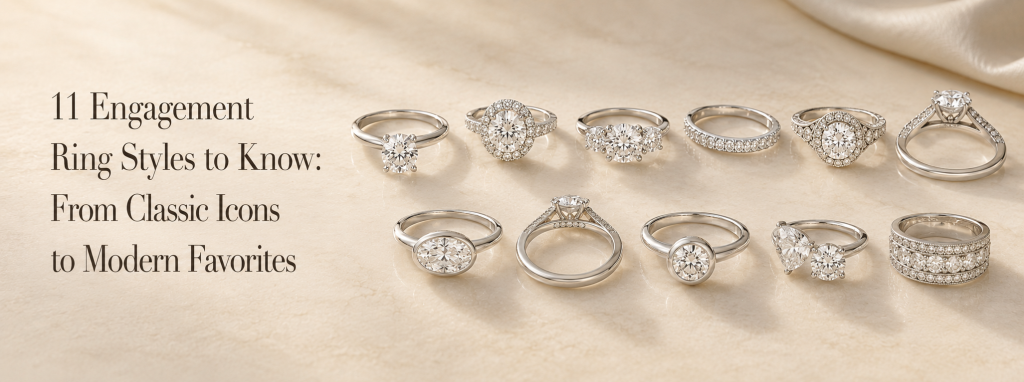
An engagement ring is more than a beautiful piece of jewelry – it is something many people wear every day for years. That makes the overall style just as important as the diamond or gemstone itself. Some designs keep the focus entirely on the center stone, while others add extra sparkle, symbolism, vintage detail, or a more contemporary silhouette.
The best choice is the one that feels natural to the wearer and works comfortably with daily life. This guide covers 11 popular engagement ring styles, from timeless solitaires to modern east-west and toi et moi designs, along with the advantages, lifestyle considerations, and design details that can help you compare them.

Quick Takeaways
- Solitaire, three-stone, cathedral, and pavé designs remain enduring choices because they balance versatility with classic appeal.
- East-west, toi et moi, hidden halo, and wide-band rings offer a more contemporary or distinctive look.
- A bezel setting is especially practical for active lifestyles because the metal rim offers added edge protection.
- The right engagement ring should suit personal style, budget, preferred center-stone shape, and everyday routine.
Engagement Ring Styles at a Glance
1.Solitaire Engagement Ring
Best for: Minimalists and anyone who wants the center stone to be the focus.
A solitaire uses one center diamond or gemstone with little or no additional stonework. Its simplicity gives the center stone maximum visual importance and makes the ring easy to pair with many wedding-band styles. Four-prong, six-prong, bezel, and cathedral variations can all be used within a solitaire design, so the final look can range from very delicate to more structured.
- Why choose it: Timeless, easy to style, and adaptable to almost every diamond shape.
- Works especially well with: Round, oval, emerald, cushion, pear, and marquise cuts.
- Lifestyle note: The setting height and prong design matter more than the simple silhouette; active wearers may prefer a lower profile or bezel variation.

2. Halo Engagement Ring

Best for: Shoppers who want extra sparkle and stronger visual presence.
A halo places a circle or frame of smaller diamonds around the center stone. The surrounding stones increase overall brilliance and can make the center appear larger from a distance. Halo designs range from very delicate outlines to bold double halos, and they can be tailored to round, oval, cushion, emerald, pear, and many other center shapes.
- Why choose it: Adds brightness around the center and creates a fuller look.
- Design option: A single halo feels refined, while a double halo makes a stronger statement.
- Lifestyle note: More small stones mean more areas that should be checked and cleaned regularly.
3. Three-Stone Engagement Ring
Best for: Couples who want symbolism with noticeable sparkle.
A three-stone ring features a main center stone with one smaller stone on each side. The design is often associated with the past, present, and future of a relationship, but it also works beautifully simply as a balanced multi-stone composition. Matching side stones create a cohesive look, while baguettes, trapezoids, pears, or rounds can add contrast.
- Why choose it: Combines meaning, symmetry, and extra diamond presence.
- Works especially well with: Emerald, oval, round, radiant, and cushion center stones.
- Lifestyle note: Consider how far the side stones extend across the finger, especially if you want a wedding band to sit flush.

4. Pavé Engagement Ring

Best for: Anyone who wants the band itself to sparkle.
In a pavé design, tiny diamonds are set closely along the shank so very little metal is visible between them. This creates a bright, continuous line of sparkle that supports the center stone rather than replacing it as the focal point. Pavé can be combined with solitaires, halos, hidden halos, cathedral settings, and three-stone rings.
- Why choose it: Adds brilliance without requiring a larger center stone.
- Style effect: Delicate pavé looks refined; wider pavé bands feel more glamorous.
- Lifestyle note: Small accent stones can be more exposed to knocks, so routine professional inspection is helpful.
5. Vintage-Inspired Engagement Ring
Best for: Shoppers drawn to romantic detail and heirloom character.
Vintage-inspired rings borrow design elements from earlier jewelry eras without necessarily being antique pieces. Common details include milgrain edges, engraved patterns, filigree, floral motifs, geometric halos, and decorative galleries. These details give the ring personality and can make even a classic center stone feel more distinctive.
- Why choose it: Rich detail creates a one-of-a-kind, story-driven look.
- Pairs beautifully with: Old European-style rounds, cushion cuts, emerald cuts, and sapphires.
- Lifestyle note: Intricate metalwork may need gentler cleaning and more careful maintenance than a simple solitaire.

6. Cathedral Engagement Ring

Best for: Those who like graceful height and architectural structure.
A cathedral setting uses raised metal shoulders or arches that rise from the band toward the center stone. This creates an elegant, lifted profile and can make the center stone appear more prominent. The arches may be plain, pavé-set, or combined with a solitaire or hidden halo.
- Why choose it: Adds height, structure, and visual drama without requiring many extra stones.
- Works especially well with: Oval, marquise, round, and elongated radiant shapes.
- Lifestyle note: A higher center setting can catch more easily than a low-profile ring, so consider daily activities.
7. East-West Engagement Ring
Best for: Shoppers who want a modern twist on an elongated stone.
An east-west ring turns an elongated center stone horizontally across the finger instead of placing it in the traditional north-south direction. The orientation alone can make a familiar diamond shape feel more contemporary and fashion-forward while keeping the rest of the ring simple.
- Why choose it: Distinctive without needing heavy decoration.
- Works especially well with: Oval, emerald, marquise, radiant, and elongated cushion cuts.
- Lifestyle note: Check the stone width across the finger to make sure the proportions feel comfortable.

8. Hidden Halo Engagement Ring

Best for: Anyone who wants extra sparkle without a visible halo from above.
A hidden halo places a row of small accent diamonds beneath the center stone, around the base of the setting. From the top, the ring can still look like a clean solitaire, but from the side it reveals an extra layer of brilliance. This makes hidden halos popular with shoppers who want a refined top view and a more detailed profile.
- Why choose it: Adds a subtle surprise of sparkle from side angles.
- Works especially well with: Round, oval, cushion, pear, and radiant shapes.
- Lifestyle note: Because the accents sit beneath the center stone, detailed cleaning around the gallery helps keep the sparkle visible.
9. Bezel Engagement Ring
Best for: Active wearers and anyone who prefers a smooth, secure profile.
A bezel setting surrounds all or part of the center stone with a thin rim of metal instead of relying only on prongs. The enclosed edge can reduce snagging and offer additional protection around the stone, making bezel designs especially practical for people who use their hands frequently.
- Why choose it: Sleek, modern, and highly protective.
- Works especially well with: Round, oval, emerald, pear, and geometric cuts.
- Design note: A full bezel feels more streamlined, while a partial bezel reveals more of the stone edge.

10. Toi et Moi Engagement Ring

Best for: Couples who want a symbolic and highly personalized design.
A toi et moi ring places two main stones together in one composition. The phrase means “you and me,” making the style naturally symbolic, but its strongest appeal is creative freedom. The stones can match or contrast in shape, size, color, or gemstone type, allowing a ring to feel very personal.
- Why choose it: Two focal stones create a distinctive, expressive design.
- Popular pairings: Pear and emerald, oval and pear, diamond and sapphire, or two complementary diamond shapes.
- Lifestyle note: Because the design is asymmetrical or wider than a solitaire, try to balance visual impact with comfortable finger coverage.
11. Wide-Band Engagement Ring
Best for: Shoppers who prefer a bold, substantial, contemporary look.
A wide-band engagement ring uses a broader shank than a traditional delicate engagement ring. The extra metal gives the design a strong visual foundation and can make even a simple solitaire or bezel setting feel more modern. Some wide bands stay plain and sculptural, while others incorporate pavé, engraving, or flush-set accents.
- Why choose it: Strong presence, modern proportions, and a substantial feel.
- Works especially well with: Bezel-set stones, solitaires, emerald cuts, ovals, and sculptural settings.
- Lifestyle note: Wider bands can fit more snugly than thin bands, so accurate sizing is especially important.

How to Choose Between Trendy and Timeless

There is no requirement to choose between “classic” and “current.” Many of the best engagement rings combine both. A solitaire can feel modern with an east-west orientation, while a vintage-inspired ring can use a clean bezel or contemporary metal profile.
Personal style: Look at the jewelry the wearer already reaches for. Minimal, refined pieces often point toward solitaire, bezel, or hidden halo designs, while more expressive tastes may suit halo, vintage, toi et moi, or wide-band rings.
Lifestyle: If the wearer works with their hands, exercises frequently, or prefers low-maintenance jewelry, prioritize smoother or lower-profile settings such as bezel or low-set solitaire designs.
Budget: More accent diamonds and intricate metalwork generally add to the cost. A simple setting may allow more of the budget to go toward the center stone, while halos and pavé can create extra visual impact with smaller accents.
Wedding-band pairing: Think about whether the wedding band should sit flush against the engagement ring. High galleries and cathedral settings often allow easier pairing, while some halos, bezels, or low profiles may require a curved or contoured band.
Center-stone shape: The same setting can look very different with different shapes. Elongated stones emphasize finger length, rounds feel balanced and classic, and geometric cuts create a sharper, more architectural look.
Which Styles Feel Most Timeless?
Solitaire, three-stone, cathedral, and pavé rings have remained popular because they are adaptable, easy to personalize, and compatible with many diamond shapes and wedding bands. These styles can still feel current when paired with modern proportions, distinctive prongs, mixed metals, or an unexpected center shape.
Which Styles Feel More Modern?
East-west settings, toi et moi designs, hidden halos, bezels, and wide bands are especially strong choices for shoppers who want something less traditional. They can still age beautifully when the overall design stays balanced and the details reflect the wearer rather than a short-lived trend.
How the Setting Changes the Look of a Ring
Prong Settings
Prongs use small metal claws to secure the center stone while leaving much of the diamond exposed. This helps maximize visibility and light return, but the number, shape, and height of the prongs can change both security and appearance.
Bezel Settings
A bezel wraps metal around the stone edge, creating a smooth outline and a more protective profile. It usually looks more modern and streamlined than a traditional prong setting.
Pavé and Bead Settings
Small diamonds are secured closely along the band using tiny beads or micro-prongs. The effect is a continuous sparkle that visually reduces the amount of visible metal.
Cathedral Settings
Raised shoulders sweep upward toward the center stone, adding height and structure. Cathedral designs can be plain or pavé-set and are often paired with solitaires or hidden halos.
Channel Settings
Accent stones sit between two parallel metal walls, creating a smooth row with no exposed prongs. This style is commonly used on bands when a sleek, durable line of diamonds is desired.
Frequently Asked Questions
What is the most versatile engagement ring style?
A solitaire is one of the most versatile choices because it works with nearly every diamond shape, metal color, and wedding-band style.
Which engagement ring style gives the most sparkle?
Halo and pavé designs generally create the strongest overall sparkle because they add multiple accent diamonds around the center or along the band.
Which style is best for an active lifestyle?
Bezel and other low-profile settings are practical choices because they reduce exposed edges and are less likely to snag during everyday activities.
Can a trendy engagement ring still be timeless?
Yes. A trend-inspired detail such as an east-west orientation or wide band can still feel lasting when the proportions are balanced and the design matches the wearer’s personal style.
What is the difference between a ring style and a setting?
The style describes the overall visual design, while the setting describes the method used to secure the stone. For example, a solitaire style can use prongs or a bezel setting.
Can engagement ring styles be customized?
Most styles can be personalized through metal choice, center-stone shape, setting height, prong style, accent stones, band width, engraving, and other design details.
