
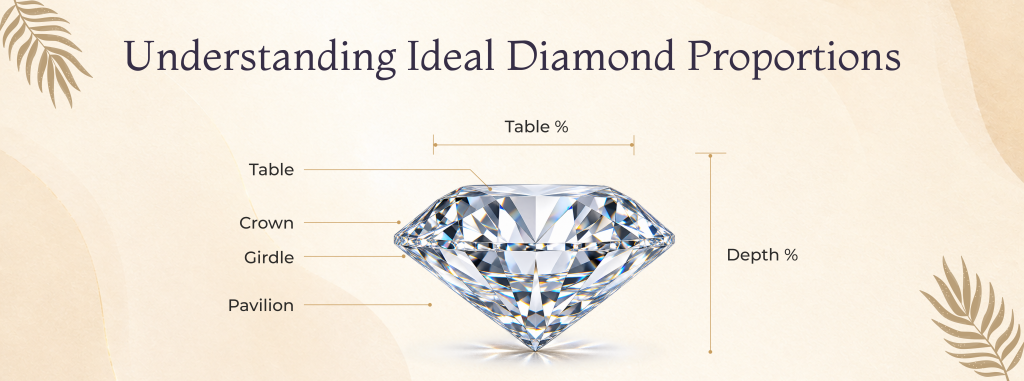
A diamond can look bright, lively, and larger than expected—or dull and smaller than its carat weight suggests—even when its color and clarity grades look excellent on paper. One of the biggest reasons is proportion. The relationship between a diamond’s table, depth, crown, pavilion, girdle, and overall outline determines how efficiently it handles light and how much of its weight is visible from the top.
This guide explains the measurements that matter, useful proportion ranges for round and fancy-shape diamonds, and how to use those numbers without treating them as a substitute for visual beauty and cut quality.
What Are Diamond Proportions?
Diamond proportions are the measurements, percentages, and angles that describe the geometry of a polished diamond. Together, they influence brightness, fire, scintillation, durability, and face-up spread.
• Brightness: the amount of white light returned to the eye.
• Fire: the flashes of spectral color created as light disperses.
• Scintillation: the pattern of sparkle and contrast seen as the diamond or viewer moves.
• Face-up size: how large the diamond appears when viewed from above.
• Durability: whether areas such as the girdle and points are proportioned safely for wear and setting.
Two diamonds with the same carat weight can have noticeably different diameters and visual impact. A stone that carries excessive weight in its depth or girdle may face up smaller, while a well-balanced cut can look brighter and more visually generous.
The Key Diamond Measurements to Understand

Table Percentage
The table is the large flat facet on top of the diamond. Table percentage compares its width with the diamond’s overall width or average diameter. It affects the balance between white-light brightness and colored fire.
Depth Percentage
Depth percentage compares the total height of the diamond—from table to culet—with its width. Excessive depth can hide weight below the girdle and reduce face-up size; overly shallow stones may lose light through the pavilion.
Crown Angle
The crown angle describes the slope above the girdle. It works with the pavilion angle to influence fire, brightness, and the overall light pattern.
Pavilion Angle
The pavilion angle describes the lower portion of the diamond. Small changes here can strongly affect light return; overly steep or shallow combinations can create darkness or leakage.
Girdle Thickness
The girdle is the outer edge where crown and pavilion meet. A very thin girdle can raise durability concerns, while an excessively thick girdle can add hidden weight without adding visible size.
Culet
The culet is the tiny facet or point at the bottom of the pavilion. In many modern diamonds, a none-to-very-small culet is preferred because a large culet can appear as a visible opening under the table.
Length-to-Width Ratio
For fancy shapes, this ratio describes the outline. It is not a direct light-performance grade, but it strongly affects style, symmetry, and how long or broad the diamond appears.
How Diamond Proportions Are Measured and Graded

Laboratory grading reports record measurements such as dimensions, table percentage, depth percentage, girdle description, culet, polish, and symmetry. For standard round brilliant diamonds, GIA also assigns a cut grade from Excellent to Poor based on a combination of face-up appearance, design, and craftsmanship—not on one “magic” set of numbers.
That point matters: proportion ranges are best used as a screening tool. A diamond should still be judged as a complete optical system because table size, crown angle, pavilion angle, lower-half facets, girdle, polish, and symmetry all interact.
Ideal Proportions for Round Brilliant Diamonds
Round brilliant diamonds have the most researched cut geometry. The ranges below are commonly used as strong screening targets for a balanced, high-performing round brilliant. They should not be treated as the only combinations capable of receiving an Excellent cut grade.
| Measurement | Useful Screening Range | Why It Matters |
| Table | 54%–58% | Balances brightness and fire |
| Total Depth | 59%–62.5% | Supports good spread without excessive hidden weight |
| Crown Angle | 34°–35° | Supports fire and balanced light entry |
| Pavilion Angle | 40.6°–41° | Critical to internal reflection and light return |
| Girdle | Thin to Medium / Slightly Thick | Avoid extremes when possible |
| Culet | None or Very Small | Helps avoid a visible opening at the center |
Important: A round diamond can fall slightly outside one of these narrow screening ranges and still perform beautifully. The combination of measurements matters more than any single number.
Shallow vs. Balanced vs. Deep Diamonds
Too Shallow
A shallow diamond may have a wider diameter for its weight, but that apparent size can come at the cost of light return. In some combinations, light escapes through the pavilion, reducing contrast and sparkle.
Well Balanced
A well-proportioned diamond directs a strong amount of light back toward the viewer while maintaining attractive spread, symmetry, and durability.
Too Deep
A deep diamond can carry extra weight below the girdle. It may have a smaller face-up diameter than another diamond of the same carat weight and can show dark areas if the angles do not work well together.
Recommended Proportion Ranges for Fancy-Shape Diamonds
Fancy shapes do not have one universally accepted “ideal” proportion formula. Their beauty depends heavily on outline, facet arrangement, symmetry, bow-tie visibility, and personal preference. The ranges below are practical screening guides—not strict pass/fail standards.
| Shape | Table Range | Depth Range | Common Length-to-Width Range |
| Asscher | 60%–68% | 61%–67% | 1.00–1.05 |
| Cushion | 58%–65% | 61%–69% | 1.00–1.20 |
| Emerald | 60%–70% | 61%–67% | 1.30–1.50 |
| Heart | 55%–62% | 58%–64% | 0.90–1.10 |
| Marquise | 53%–63% | 58%–62% | 1.75–2.25 |
| Oval | 53%–63% | 58%–62% | 1.30–1.50 |
| Pear | 53%–63% | 58%–62% | 1.45–1.75 |
| Princess | 63%–75% | 68%–75% | 1.00–1.05 |
| Radiant | 61%–69% | 61%–67% | 1.00–1.20 |
How Proportions Affect Carat Weight and Visual Size
Carat measures weight, not dimensions. That is why two 1.00-carat diamonds can look different in size. A stone with excessive depth or a very thick girdle may carry more weight where you cannot see it, while a well-spread stone places more of its weight across the visible face-up area.
This does not mean “shallower is always better.” Chasing maximum diameter can reduce brilliance if the optical angles are compromised. The best value usually comes from balancing face-up size with strong light performance.
How Diamond Proportions Can Affect Price
Diamonds with strong cut quality and desirable proportions often cost more because achieving those results can require greater precision and more loss of rough material during cutting. Well-cut stones also tend to look brighter and more lively, which increases demand.
A slightly smaller diamond with excellent light performance can often have more visual impact than a heavier diamond with poor proportions. For many buyers, prioritizing cut and proportion before chasing the highest possible carat weight produces the better-looking ring.
How to Choose a Well-Proportioned Diamond
- Start with cut quality. For round brilliant diamonds, begin with Excellent or Very Good cut grades when budget allows, then compare individual stones.
- Read the grading report. Check table, depth, dimensions, girdle, culet, polish, and symmetry instead of relying on carat weight alone.
- Compare millimeter dimensions. Face-up measurements reveal whether the diamond carries its weight efficiently.
- Evaluate angles together. Crown and pavilion angles should be considered as a pair because their interaction influences light return.
- Inspect the actual diamond. Use high-resolution video, 360-degree views, or in-person comparison—especially for fancy shapes.
- Watch for extremes. Very thick girdles, excessive depth, very shallow profiles, poor symmetry, or obvious bow ties can reduce beauty or visual size.
- Balance numbers with preference. The most attractive diamond is not always the one with the most textbook measurements. Pattern, contrast, shape personality, and your own taste matter.
Frequently Asked Questions
A commonly used screening target is roughly a 54%–58% table, 59%–62.5% depth, 34°–35° crown angle, and 40.6°–41° pavilion angle, with a sensible girdle and little or no culet. However, GIA cut grading is based on combinations of factors rather than one fixed formula.
Is table percentage or depth percentage more important?
Not in the same universal way as round brilliants. Recommended ranges are useful for filtering, but visual assessment is especially important for fancy shapes.
Yes. Extra weight below the girdle can reduce the visible face-up diameter, so a deeper stone may look smaller than another diamond of the same carat weight.
It may have a larger diameter, but overly shallow proportions can reduce light return. Bigger spread is only useful if the diamond still looks bright and balanced.
For visual beauty, cut quality is usually the stronger priority. A well-cut slightly smaller diamond can appear brighter, more dynamic, and sometimes even visually larger.
It is a strong starting point, but diamonds within the same cut grade can have different patterns and visual personalities. Compare the actual stones whenever possible.
