
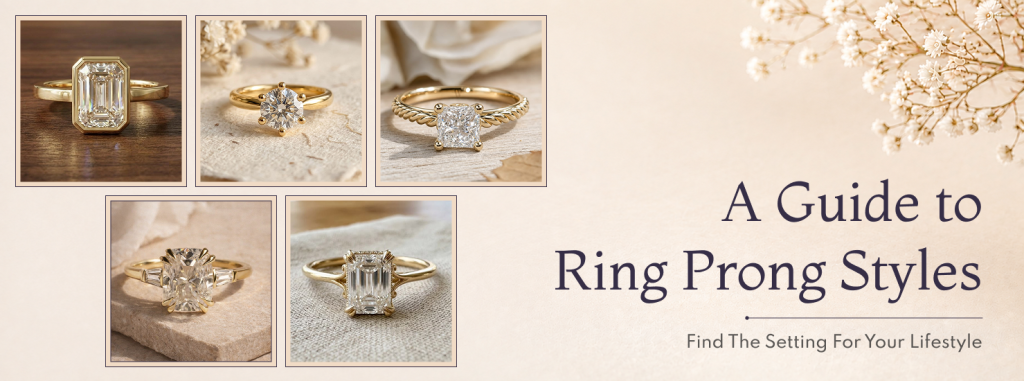
Introduction
When choosing an engagement ring, the center stone usually gets most of the attention, but the small pieces of metal holding it in place can change the ring just as much. Prongs influence how much of the diamond is visible, how securely its edges are protected, how much light reaches the stone, and how the ring feels during everyday wear.
Some prongs are rounded and traditional, others are pointed and delicate, and some are designed specifically to protect sharp corners. A bezel, while technically a different setting style rather than a prong, is also worth comparing because it offers the highest level of edge protection. Understanding these options makes it easier to choose a setting that suits both your diamond and your lifestyle.
Ring Prong Style at a Glance
| Setting Type | Best For | Visual Effect | Security Level |
| Round Prongs | Round, oval, cushion | Soft, classic dots | Secure |
| Claw Prongs | Round, oval, princess, cushion | Fine pointed tips; minimal metal | Very secure |
| Double Prongs | Larger stones; emerald, Asscher, oval | Paired prongs with a designer look | Very high |
| Split Prongs | Larger round, cushion, oval stones | One prong divides into two tips | Very high |
| V-Prongs | Pear, marquise, princess, heart | Protective V or corner cap | Very high |
| Flat / Tab Prongs | Emerald, baguette, Asscher | Geometric, squared-off ends | Secure |
| Bezel Setting | Most shapes, especially active-wear rings | Metal rim around the stone | Maximum |
Round Prongs
Round prongs, sometimes called ball prongs, finish with smooth circular tips. They are one of the most familiar choices for engagement rings and create a neat, traditional outline around the center stone.
Best for: Round, oval and cushion-cut diamonds; classic solitaire and three-stone designs.
Appearance: Soft, symmetrical and timeless. The rounded tips are visible but usually do not dominate the diamond.
Why choose it: A versatile option that works with many ring styles and gives a balanced combination of visibility and security.
Keep in mind: Because the tips are rounded, they can look slightly more substantial than fine claw prongs. As with any prong setting, they should be checked for wear or loosening over time.
Round Prongs
Round prongs, sometimes called ball prongs, finish with smooth circular tips. They are one of the most familiar choices for engagement rings and create a neat, traditional outline around the center stone.

Best for: Round, oval and cushion-cut diamonds; classic solitaire and three-stone designs.
Appearance: Soft, symmetrical and timeless. The rounded tips are visible but usually do not dominate the diamond.
Why choose it: A versatile option that works with many ring styles and gives a balanced combination of visibility and security.
Keep in mind: Because the tips are rounded, they can look slightly more substantial than fine claw prongs. As with any prong setting, they should be checked for wear or loosening over time.

Claw Prongs
Claw prongs taper to a narrow point as they reach over the edge of the diamond. Their slim profile minimizes the amount of visible metal, helping the stone remain the visual focus.
Best for: Round, oval, cushion and princess cuts; modern solitaires and delicate engagement rings.
Appearance: Fine, pointed and refined. Petite claw versions appear even slimmer and more delicate.
Why choose it: A strong choice when you want maximum diamond visibility and an elegant, high-end look without sacrificing security.
Keep in mind: Very fine claws can catch on fabric if they are raised or worn. Proper finishing and routine inspection are important.
Double Prongs
Double prongs place two small prongs together at each support point. They may be rounded or claw-shaped and create more contact points around the stone.

Best for: Larger center stones, emerald cuts, Asscher cuts, ovals and other designs where extra support is desirable.
Appearance: More noticeable than single prongs, with a distinctive designer or vintage-inspired character.
Why choose it: The paired construction gives added reassurance for valuable or larger stones while also becoming part of the ring’s visual identity.
Keep in mind: Because there is more metal around the stone, double prongs can slightly reduce the open, minimal appearance of the setting.

Split Prongs
A split prong begins as a single support and divides into two smaller tips near the gemstone. This creates additional contact points without requiring two completely separate prongs from the base.
Best for: Larger stones, especially round, cushion and oval diamonds that benefit from added support.
Appearance: Detailed and refined, with a slightly decorative appearance around the stone.
Why choose it: Split prongs can increase security while keeping the setting airy enough for light to reach the diamond from multiple directions.
Keep in mind: The extra detail should be carefully proportioned so the prongs enhance rather than crowd a smaller stone.
V-Prongs
V-prongs are shaped to wrap around and protect a pointed corner. Instead of pressing a small tip over the stone, the metal forms a V- or corner-like guard around a vulnerable point.

Best for: Pear, marquise, princess and heart-shaped diamonds, as well as other gemstones with exposed points or corners.
Appearance: Geometric and protective, with the V shape visibly framing the diamond’s tip.
Why choose it: Pointed diamond shapes can be more vulnerable to chipping at their tips, so V-prongs are a practical way to protect those areas while preserving the outline of the cut.
Keep in mind: V-prongs are shape-specific and need to be carefully fitted to the stone so they protect the corner without appearing bulky.

Flat / Tab Prongs
Flat or tab prongs have squared or flattened ends rather than rounded or pointed tips. Their geometry makes them less common and more visually distinctive.
Best for: Emerald, baguette, Asscher and other rectangular or square-cut stones.
Appearance: Structured, architectural and often Art Deco-inspired.
Why choose it: They complement straight-edged diamonds beautifully and can add a strong design detail to an otherwise simple ring.
Keep in mind: Because the prongs are wider and more visible, they create a bolder metal presence than claw or round prongs.
Bezel Setting
A bezel setting does not use individual prongs. Instead, a thin rim of metal surrounds all or part of the stone’s perimeter, holding it securely and shielding its outer edge.

Best for: Nearly any diamond shape; especially useful for larger stones, fancy cuts, low-profile rings and active lifestyles.
Appearance: Smooth, contemporary and streamlined, with a defined metal border around the gemstone.
Why choose it: A bezel offers excellent protection from knocks, snags and edge damage, making it one of the most secure setting choices.
Keep in mind: Because more metal surrounds the diamond, less of the stone’s side profile is exposed and slightly less light may enter compared with an open prong setting.
Choosing the Right Number of Prongs
The shape of the prong is only part of the decision. The number of prongs also affects security, diamond visibility and the overall look of the ring. Four- and six-prong arrangements are the most common, while eight-prong designs are generally reserved for larger stones or styles where extra support is a priority.
| Prong Count | Typical Styles | Common Use | Visual Effect |
| 4 prongs | Round, claw, V, tab | Many solitaire and fancy-shape rings | More open; more stone visible |
| 6 prongs | Round or claw | Often used for round stones and larger center diamonds | Balanced, classic and more enclosed |
| 8 prongs | Double or split arrangements | Very large stones or designs needing extra support | More metal presence; high security |
Important: There is no universal carat-weight rule for prong count. The best arrangement depends on the stone’s dimensions, cut, girdle, ring design, metal, setting height and the jeweler’s engineering recommendations.
How to Choose a Prong Setting
The best setting is the one that balances the look you love with the amount of protection your ring needs. Consider these factors before deciding:
- Aesthetic: Round and claw prongs keep the look classic and stone-focused, while tab, split and double prongs make the setting itself more noticeable. Bezels create a sleek, modern outline.
- Lifestyle: If you work with your hands, exercise frequently, travel often or prefer a low-maintenance ring, a bezel or more protective prong arrangement may be a better fit.
- Diamond shape: Pointed shapes such as pear and marquise often benefit from V-prongs; rectangular cuts pair naturally with tab prongs; rounded shapes are especially compatible with round or claw prongs.
- Diamond size: Larger stones may benefit from more support points or sturdier prongs, but the setting should still be proportionate to the stone.
- Metal choice: White gold or platinum prongs can visually blend with a colorless diamond, while yellow or rose gold creates a warmer frame. Mixed-metal settings can combine both effects.
Setting height: Lower settings tend to feel more protected and practical, while higher settings can expose more of the stone and allow easier pairing with some wedding bands.
Which Setting Fits Your Lifestyle?
| Lifestyle | Good Options | Why |
| Active / hands-on | Bezel, V-prong, double prong | More edge protection and added support |
| Everyday classic | Round prong, six-prong | Timeless look with dependable security |
| Minimal / modern | Claw prong, bezel | Clean lines and strong focus on the center stone |
| Vintage / Art Deco | Flat/tab, split, double | More visible metal detail and geometric character |
| Maximum sparkle focus | Claw or slim round prongs | Less metal covers the stone |
How to Care for Ring Prongs
Prongs are small, but they do the essential job of holding your diamond in place. Regular care can reduce the chance of a loose or damaged setting.
- Check the ring occasionally for prongs that look bent, lifted, worn or uneven.
- If the center stone moves, clicks or feels loose, stop wearing the ring and have it inspected promptly.
- Have frequently worn engagement rings professionally inspected and cleaned on a regular schedule; many jewelers recommend at least an annual check.
- For gentle at-home cleaning, use warm water, mild soap and a soft brush unless your jeweler gives different instructions for the specific gemstone or metal.
- Avoid exposing the ring to harsh chemicals and remove it for activities that can cause hard impact, pressure or snagging.
- Do not attempt to bend or tighten prongs yourself; setting work should be handled by a professional jeweler.
Frequently Asked Questions
A full bezel generally offers the greatest edge protection because metal surrounds the stone. Among traditional prong settings, double, split and well-designed V-prongs can provide high security for the shapes they are intended to protect.
Not necessarily. More prongs can add support, but they also add visible metal. The best choice depends on the diamond shape, size, setting design and how you plan to wear the ring.
Fine claw prongs or a simple four-prong design can make more of the diamond visible because less metal covers its outline. The actual size does not change, but the open setting can create a larger visual impression.
V-prongs are commonly used on pointed tips because they help shield those vulnerable areas from impact.
Yes. Their smooth profile and protected edges make bezels especially practical for active lifestyles, though they create a different look and expose less of the diamond than an open prong setting.
For a ring worn every day, a professional inspection at least once a year is a sensible baseline, with earlier checks if the ring is knocked, snagged or the stone feels loose.
